Modular Enterprise Content Architecture: The Strategic Foundation of Modern Publishing
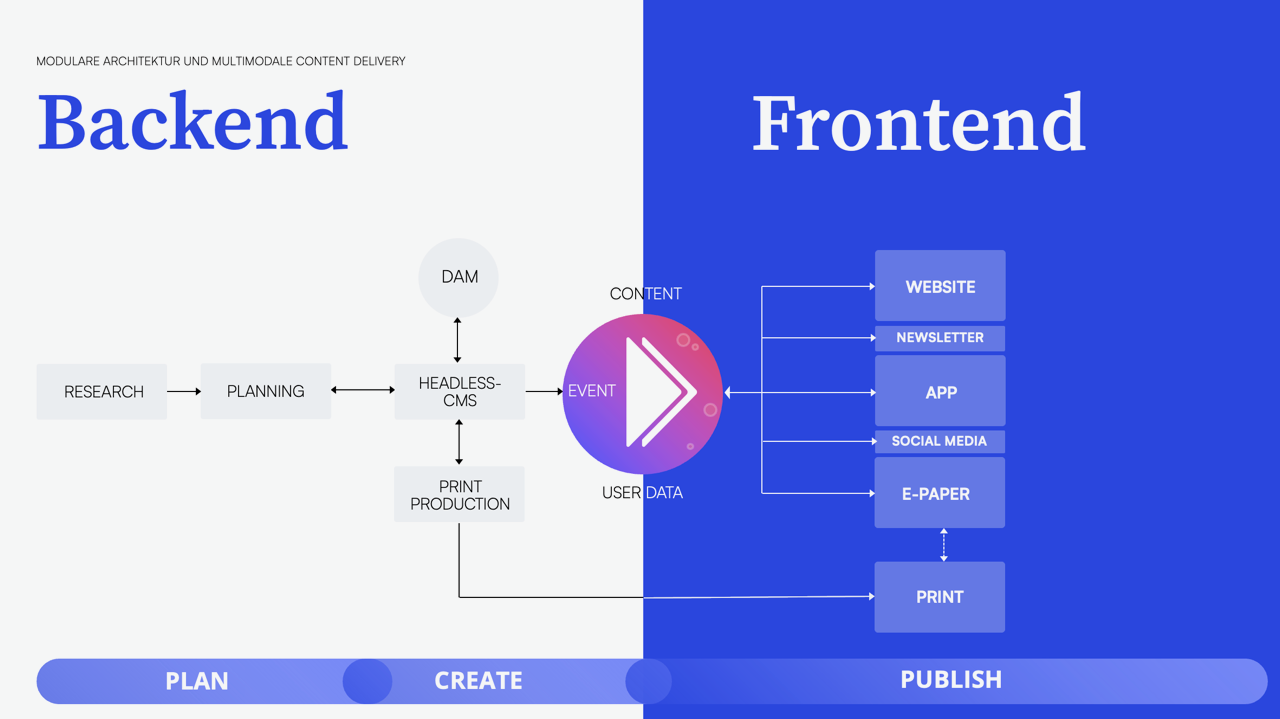
Publishing infrastructure is under constant pressure. Content must be instantly available, combined and repurposed across formats, and consistently delivered – across websites, apps, newsletters, social media and print. It’s a challenge that modular enterprise content architecture is uniquely positioned to solve.
Why Enterprise Content Architecture Is No Longer Optional
Modular content architecture represents a fundamentally different approach: rather than managing content as static, siloed blocks, it structures it as clearly defined, reusable components. The result is greater operational efficiency, shorter time-to-audience and a foundation for consistent experiences across every channel.
Publishers who invest in these structures early avoid costly technical debt and retain the ability to replace or upgrade individual system components without touching the broader architecture. Modularity, by design, future-proofs your technology investment.
Enterprise content architecture is not purely a technical discipline — it sits at the heart of how publishers evolve their businesses and stay competitive.
Legacy backend systems have typically grown organically over time: disparate databases, frequent CMS queries, multiple caching layers, complex denormalization on every single request. The consequences are predictable: high complexity, enormous redundancy, unnecessary infrastructure costs and slow page load times.
Our experience across many client projects reveals a telling imbalance: systems routinely handle hundreds of requests per second, while the underlying content changes only a few hundred times a day. A ratio of a thousand to one is putting unnecessary pressure on the CMS. Modern modular architectures address this directly: clearly defined data models, pre-processed content delivery via a headless CMS, modular frameworks replacing monolithic systems, and intelligent caching strategies that avoid redundant data processing. The result: faster, more reliable content delivery, lower hosting costs and an infrastructure that scales with business growth.
Content Architecture Is Business Architecture
Enterprise content architecture reaches far beyond the technical layer. It enables new, flexible business models such as personalised news feeds, dynamic paywalls, rapid time-to-publish for new content offerings. It simplifies third-party system integration and eliminates siloed solutions and redundant data stores. And it creates AI-driven workflows that take real pressure off editorial and product teams.
In this way, modular enterprise content architecture accelerates time-to-market for product innovation and allows publishers to adapt their business models quickly as audience behaviour and market conditions shift.
The Case for Architectural Renewal
What we consistently see across client projects: the most significant breakthroughs happen when organisations are willing to challenge existing complexity head-on and rebuild their architecture from the ground up. Moving from fragmented, legacy systems to coherent, high-performance architectures requires conviction – but the organisations that make this shift gain an advantage that only grows as the organisation does.
Our Takeaways
Modular enterprise content architecture sits at the heart of any future-ready publishing model. It connects the technology layer with editorial and business strategy, creating better experiences for audiences while driving operational efficiency and long-term growth.
Publishers who modernise their architecture today gain something more valuable than a technology upgrade: the ability to launch new products, enter new channels and respond to market shifts – without rebuilding from scratch every time.